Alba Notes

The note is written.
The judgement stays yours.

Record a meeting or a phone call, and get the note: eight templates that write down what was said, organised so a colleague can find it. They do not assess, diagnose, or propose. That is not a limitation we are apologising for. It is the product.
Watch the film two minutes · how a session becomes a record

iPhone beta on TestFlight Get it on Google Play

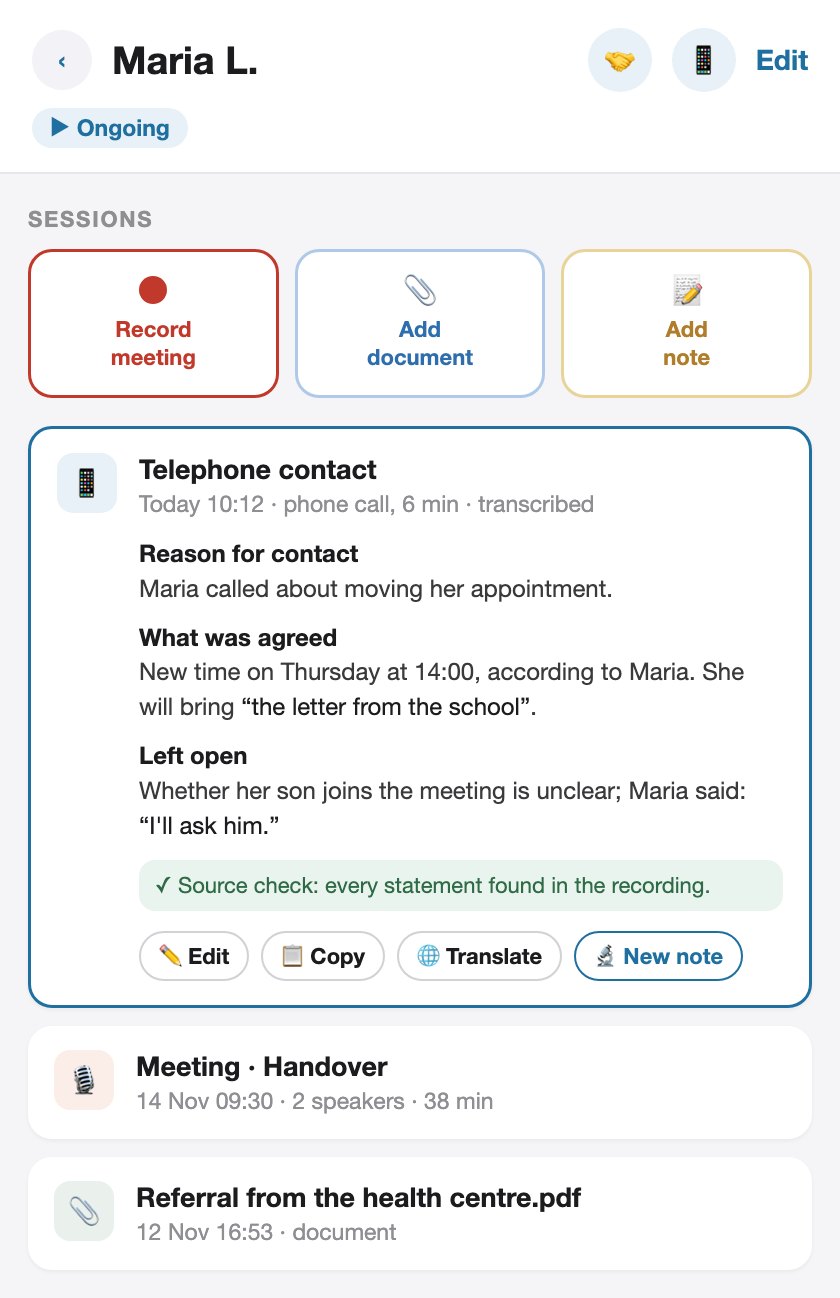
The client page in Alba Notes: record a meeting, add a document or a note, phone the client, share the client with a colleague. An open telephone note shows what was agreed and what was left open, with its source check.
Record the meeting or the call. The note follows from it. Names and content are invented.

How it works

From a conversation to a note, in three steps.

You talk with your client as you always do. Alba Notes listens, writes it down, and hands you a draft to read and adopt.

1 · Record

A meeting, a call, or a file

Record in the room, phone your client from the app, or upload an audio file you already have.

2 · Transcribe

Every word, every speaker

Speech becomes text in 14 languages, with speakers kept apart when several people talk.

3 · Document

A note you can sign

Pick a template. A second model checks the note against the recording before you see it.

Everything in the app

More than notes: one place for the whole case.

The documentation is the heart of it. Around it sits what a clinician needs on an ordinary day: the phone, the colleagues, and the files.

🎙️

Record a meeting Basic

Start recording in the room. Schedule a recording, or email the result to the people who were there.

📎

Upload audio and documents Basic

Bring in an audio file, or a PDF, Word file, text or photo of a page. Photos are read on the device.

📝

Eight note templates Basic

Documentation note, journal entry, agreed actions, handover, telephone contact, coordinated plan, consent record and meeting notes.

✍️

Edit, copy, translate Basic

Edit the draft and keep the original. Copy it with formatting into your record system, shorten it, translate it, anonymise it or email it.

📱

Phone your client Premium

Call a client's phone number from the app. The call is recorded and transcribed, so the telephone note writes itself.

🤝

Share a client with a colleague Premium

Give a colleague read or write access to a client's file. They accept the invitation in their own app.

💬

Talk with colleagues Premium

Chat, voice calls and video calls with colleagues inside the app. Calls are recorded and transcribed, like any meeting.

✉️

Reach colleagues by SMS Premium

Message a colleague's phone from the chat. Their reply comes back into the same thread.

🌍

14 languages

English, Swedish, Danish, Finnish, Norwegian, Icelandic, German, French, Spanish, Italian, Chinese, Russian, Brazilian Portuguese and Polish, or let it detect the language.

What it does, and what it will not do

Most of what makes a documentation tool safe is what it declines to write. Both halves below are enforced by the same rules, applied to every template from one place.

It records

  • What the patient said, in their own words, quoted where it matters
  • What the clinician said, attributed to them
  • What was agreed, by whom, and by when — where the conversation says so
  • What was raised and left unsettled
  • Questions that were asked and never answered
  • What the source does not contain, stated plainly rather than filled in

It does not

  • Weigh findings or consider what speaks for or against a diagnosis
  • Name a diagnosis unless the patient did
  • Describe clinical signs — no mental status examination, no judgement about affect
  • Propose treatment, follow-up or investigation, even where it seems obvious
  • Resolve an ambiguous answer into a clear one
  • Decide who was speaking when the recording does not say

Eight documents, one set of rules

The templates differ in their sections. Everything that makes them safe is identical, held in one place — so a rule tightened on one is tightened on all of them.

documentation note

The full record of a session

Headings drawn from what the conversation actually covered, in the patient's own terms.

journal entry

Under the established keywords

Reason for contact, Current situation, History, Action, Plan — and deliberately no Assessment.

agreed actions

What was decided

Decisions, what was raised and not decided, what was postponed, and questions left unanswered.

handover

For the colleague taking over

Every outstanding item the conversation named, including the ones mentioned in passing.

telephone contact

A call, recorded as a call

What was said, what information was given, what was agreed. Advice is recorded, never completed.

coordinated plan

Several parties, one person

What each party undertook, where they disagreed, and what nobody took responsibility for.

consent record

What was asked, what was answered

Never that anyone consented. Whether an exchange amounts to consent is a judgement, not a transcription.

meeting notes

The everyday one

A straightforward note from a recorded meeting, with the same source check as the rest.

What comes back

An extract from a handover note, produced from a recorded conversation between two clinicians. Note where the lab result appears — twice, because it exists and because nobody has looked at it.

What has been done
  • Three sessions completed, according to Anna.
  • Mirtazapine started at a low dose, according to Anna.
  • Blood tests from Monday exist — Anna referred to them.
What is outstanding
  • Anna stated that she has not yet looked at Monday's blood tests.
  • Whether the patient has contact with child psychiatry for her son is unclear; Anna said: I don't actually know.
The situation as it was described
  • Anna stated: My feeling is that she's moving in the right direction but that she under-reports how bad it is at home.
Source check Every statement above was checked against the recording by a second model. It reports anything absent from the source and anything interpreted. On this note: no findings.

Anna's impression is quoted and attributed to her. It is not adopted as the document's own finding — that distinction is the whole of it.

The constraints are built, not promised

Anyone can write “it does not diagnose” in a brochure. These are the mechanisms that hold it, and they are inspectable.

One rule set, one place

Every template includes the same rules rather than carrying its own copy, so none of them can quietly drift away from the others.

A second model checks the first

It reads the conversation and the finished note, and reports any statement that is absent from the source or has been interpreted. Its findings are appended to the note, not hidden in a log.

Headings are written by the server

Not chosen by the model. Two notes carry the same headings, and a required section cannot go missing without the note saying so.

Some words are blocked in code

The consent record cannot state that anyone consented. That check runs in ordinary code, not by asking a model to remember — while the same words are left untouched inside a quotation, because somebody may have said them.

Plans

Start free. Upgrade when the case needs more.

Basic gives you the whole documentation tool at no cost. Premium adds the phone, your colleagues and more room to work.

Basic

Free
for every clinician
  • Record meetings in the room
  • Upload audio files and documents
  • All eight note templates, with the source check
  • Edit, copy, shorten, translate, anonymise and email
  • 14 languages
  • A monthly usage allowance included

No card needed. We set up your Basic account and email you how to sign in.

Already have an account? Log in.

Security

Built for confidential conversations.

What a client says to you stays between you, the client and the record.

Processed in SwedenFor European accounts, speech and text are processed in Sweden, on our server in Stockholm.
Two-step sign-inAn authenticator app is required, and you can add a passkey.
Encrypted at restThe database is encrypted with AES-256.
Audio on your termsKeep the recording, delete it after transcription, or delete it after seven days.

Where it sits

Alba Notes produces documentation of a conversation. It does not assess, diagnose, screen, or propose treatment, and it is not intended to inform a diagnostic or therapeutic decision. It is not a medical device.

Every document is a draft for the clinician to read, correct and adopt. The clinician remains the author of the record and is responsible for its accuracy.

TalkToAlba's assessment products are a separate matter and are regulated as such. Nothing on this page describes them.